
Stablecoins Are Scaling Fast. That Makes Execution Quality the Real Product
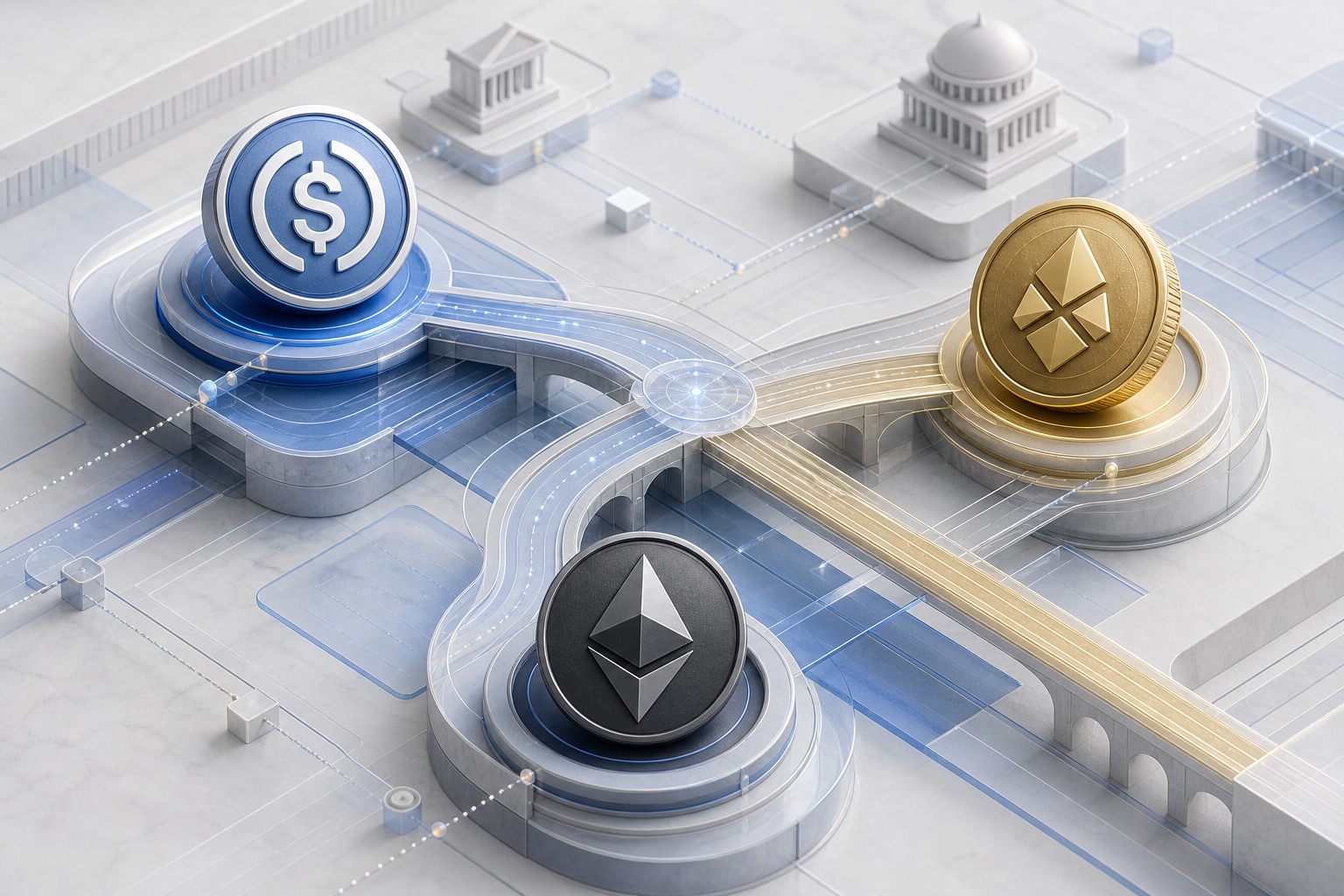
Stablecoins are scaling into real payment and trading infrastructure. That does not remove friction. It raises the cost of weak routing, fragmented liquidity, and slow asset transitions.
Stablecoins Are Scaling Fast. That Makes Execution Quality the Real Product
Circle's latest results made one thing clear: stablecoins are no longer a side story. In results published on May 11, 2026, Circle said USDC in circulation reached $77.0 billion, up 28% year over year, while USDC onchain transaction volume hit $21.5 trillion in Q1, up 263%.
A day later, Mesh announced a formalized partnership with Tempo around stablecoin payments at scale, emphasizing sub-second finality, stablecoin-native gas fees, and payment rails designed for predictable settlement. And earlier this month, Circle also pushed native USDC and CCTP on Injective, reinforcing the direction of travel: native dollars, cleaner crosschain movement, less tolerance for wrapped-asset friction.
That is the headline layer.
The deeper story is that once stablecoins become bigger, faster, and more widely integrated, execution quality stops being a background issue. It becomes the product.
Stablecoin growth changes what users expect
When stablecoins are small, users tolerate awkward workflows.
They bridge manually. They compare routes by hand. They bounce between wallets, apps, and chains just to finish one move. They accept that one transfer may become three separate decisions.
That breaks down when stablecoin usage starts to scale.
As more liquidity, trading activity, and payment flows move through assets like USDC, users stop thinking about stablecoins as a novelty. They start treating them like infrastructure. And infrastructure is judged differently.
Users expect:
- reliable access to the asset they want
- predictable movement across chains and ecosystems
- less value lost to bad routing or unnecessary hops
- faster transitions between stablecoins, majors, and risk assets
At that point, product quality is no longer about simply listing the asset. It is about how efficiently users can act once they have decided to move.
More rails do not automatically mean better execution
This is the trap the market keeps falling into.
Every new settlement partnership, chain integration, or native stablecoin launch looks like a pure improvement. In one sense, it is. More connectivity usually expands the surface area for liquidity and use cases.
But users do not experience surface area. They experience outcomes.
A larger stablecoin ecosystem can still produce poor user results when:
- liquidity is fragmented across venues and chains
- the best route is hard to discover in real time
- users must manually stitch together steps
- speed and finality differ meaningfully across paths
- one extra hop quietly worsens the effective execution price
That means growth in rails can actually increase the importance of routing discipline. More options create more room for execution mistakes.
Why this matters beyond payments headlines
The language around stablecoins often focuses on adoption, remittances, institutions, or settlement efficiency. All of that matters.
But in practice, users rarely stay in one static state.
They move from stablecoins into majors when momentum shifts. They rotate from majors back into dollars when risk rises. They reposition around funding rates, treasury flows, onchain opportunities, or macro headlines. Even payment-driven flows can end with a portfolio decision.
That is where execution quality matters most.
The real question is not whether a chain now supports native USDC. It is whether users can move from intent to completion cleanly once the market gets busy.
Can they rotate without opening five interfaces? Can they access deeper liquidity without guessing? Can they preserve more value when they shift between assets? Can they get a cleaner path during fast market conditions instead of the most obvious but least efficient route?
Those are product questions, not just infrastructure questions.
Stablecoin scale is turning routing into a core layer
The more serious stablecoins become, the less acceptable sloppy routing becomes.
If billions more dollars are moving through onchain rails, then route discovery, liquidity access, and execution quality are no longer secondary UX concerns. They sit inside the value proposition.
That is especially true in a market where users increasingly move across:
- stablecoins and majors
- Ethereum, Base, and new payment-oriented chains
- trading, treasury, and payment use cases
- human-driven and agent-driven flows
In that environment, the edge is not just being connected to more rails. The edge is converting that connectivity into cleaner execution.

What teams should watch next
Over the next phase of market growth, the strongest onchain products are likely to be the ones that reduce operational drag instead of just adding another integration badge.
Watch for teams that make these transitions easier:
- stablecoins into majors
- majors back into defensive positions
- crosschain stablecoin movement without fragile wrappers
- payment flows that end in portfolio reallocations
That is where market structure becomes user experience.
And that is where execution starts compounding.

Where OneSwap fits
OneSwap matters in the part of the workflow where users actually feel the market.
As stablecoin infrastructure scales, the winning experience will not come from noise, branding, or raw chain count alone. It will come from helping users move between assets with less friction, better routing, and stronger execution when it counts.
That is the difference between watching stablecoin growth and building for what it actually demands.
If stablecoins are becoming a core financial rail, then execution quality becomes a core product layer too.
Explore smoother cross-asset execution at https://oneswap.ai.